
The Importance of Paint in Interior Design
 The Importance of Paint in Interior Design
With 20 years of experience as an interior designer and 30 years as a decorative artist, I have used a lot of paint. Along the way, I have learned exactly how and where to use it effectively.
My journey with color began as a young artist. Mural painting, faux finishing, and decorative wall treatments require massive quantities of paint compared to working on canvas. To manage this, I mastered color mixing using specialized tints, learning the color wheel like the palm of my hand. Later, at The Art Institute, wonderful instructors elevated my technical skills, teaching me color-mixing techniques at a level I had never seen before.
When I launched my decorative artistry business, interior designers became my primary clients. Armed with my BA in interior design, I viewed this as an incredible opportunity to learn from them while bringing their creative visions to life.
Suddenly, precision mattered more than ever. I had to select the exact right medium for every technique, oils for glazes, latex for sponge painting, and acrylics for murals. I also had to navigate different brand preferences, project demands, and sheen levels for multiple clients at once. Managing vendors quickly made me an expert on the leading paint manufacturers:
-
- Benjamin Moore: My choice for high-end clients seeking thick, silky, luxury coatings.
- Sherwin-Williams: The go-to for exceptional durability and specialized coatings built to withstand varying climates.
- Behr (Home Depot): A reliable, good-quality option ideal for budget-conscious projects or large-scale coverage.
True paint selection requires skill that goes far beyond the hand of the painter. It demands a deep understanding of quality, durability, finishes, and spatial geometry. When selecting paint for any interior, I focus heavily on three core elements:
1. Lighting
Natural and artificial light can make or break a design. A paint that looks beautiful under nighttime lighting might produce an aggressive glare in natural daytime sunlight. To find a happy medium, you can either adjust your window treatments to filter daylight or tone down the paint finish. I find that flat or eggshell finishes perform beautifully under modern LED lighting.
2. Color & Neutrality
While my firm, Artistic Interiors, designs across all styles, we specialize in Modern-Coastal interiors. This means I frequently lean toward a light, neutral palette. However, every design style dictates its own rules. Traditional interiors demand deep, period-accurate tones, while Mid-Century Modern designs require highly specific, era-reflective hues.
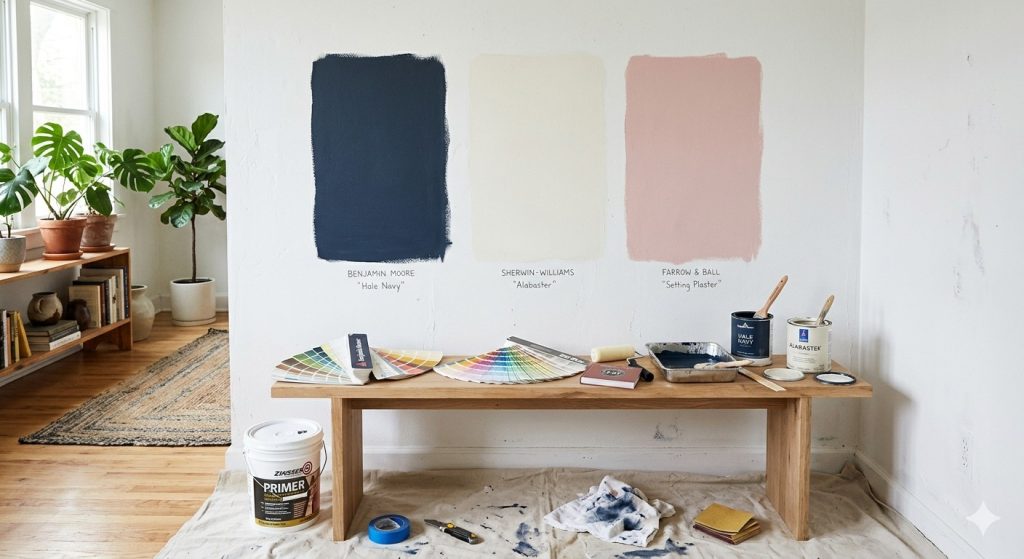
Regardless of the style, always test your color swatches directly on the wall. Evaluate them in the morning, afternoon, and evening light. Place your furniture and fabric samples right next to these swatches to confirm they harmonize. Decide early on whether your wall color should command attention as a bold accent or act as a neutral backdrop that lets the decor take center stage.
3. Finish or Sheen
Choosing the correct sheen is a critical design decision. A high-gloss wall looks elegant and high-end if professionally sprayed on a perfectly smooth surface, but it can look cheap if it accentuates drywall imperfections.
-
- Light & Texture: Glossier finishes work beautifully in darker rooms with minimal light, while eggshell, matte, and flat finishes excel in bright, light-flooded spaces.
- Durability: High-traffic areas, or homes with children and pets, require a higher sheen for easy wiping and longevity.
- Pro Designer Tricks: To make a low ceiling in a dark room feel taller and brighter, use a gloss finish to mirror the light and space below. Additionally, always paint woodwork and trim in at least a satin finish for maximum durability. Finally, if you use metallic tones on walls, keep them sparse and contrast them against a low-luster paint.
I hope these insights come in handy for your next painting project!